
The Modern Advertising Guide for Government Agencies

Reaching every residentand customer across the screens we use every day depends on a coordinated mix of video, connected TV, display ads, and social media advertising. Public andgovernment agencies can connect with their audience with cohesive messaging and omnichannel campaigns that turn outreach into real stories with measurable results.
For decades, a government agencywanting to reach the public had a short menu: a billboard, a newspaper ad, aradio spot, and maybe a local TV buy. The message went out, and whether itlanded was mostly a matter of faith. That era is over.
Residents now split their attention across digital devices – a streaming show on TV, a phone in their hand, a podcast in the car, and a feed that refreshes every few seconds. An agency orcounty district announcing a new benefits program, a public health initiative, a recruitment drive, or school enrollment campaign has to meet people acrossall devices — at the right moment, in the right language, with a message that actually fits their behavior and screen.
The good news is that the technologyfragmenting attention has also made it possible to reassemble it. Precisiontargeting, AI-driven optimization, and unified measurement mean a modest publicbudget can now do what only national brands could a decade ago.
In fact, global ad spending crossed the trillion-dollar mark in 2026 — with connected TV and social media leading all channels in projected growth. The public sector can ride the same infrastructure private brands use.
An integrated, omnichannel approach —not channels in silos — delivers the reach, visibility, and credibility thatgovernment outreach and education demands. This article walks through the top trendsreshaping advertising in 2026 and how to create cohesive ad campaigns that reachaudiences everywhere.
Trend 1: AI moves from buzzword to backbone
Artificial intelligence stopped being a novelty in advertising and became the engine underneath it. In 2026, AI isn'tjust adjusting bids — it plans campaigns, builds audiences, versions creative,selects inventory, and analyzes results. And yet most organizations have not integratedAI across the campaign lifecycle. That gap is exactly where an agile agencypartner creates an edge.
What does this mean for a publiccampaign? Dynamic Creative Optimization (DCO) lets a single ad concept like“apply for winter heating assistance” automatically reshape itself into variations by neighborhood, language, weather, or device. The data behind the approach is striking: campaigns using DCO deliver a 32% higher click-through rate and a 56%lower cost per click, and machine-learning bidding models have been shown to cut cost-per-action by roughly 23% by predicting which impressions convert.
For government or county agencies, bound by fairness and stewardship obligations, AI's benefit is efficiency with accountability: fewer wasted impressions, cleaner reporting, and the ability to prove that public dollars reached the intended public.
“The question is nolonger whether to use AI in public-sector advertising — it's whether yourcompetitors for attention are already using it better than you.”
Trend 2: Video makes the emotional connection
If AI is the engine, video is the sportscar. Attention gravitates to motion, and video now represents about half of programmatic ad spend. Interactive and dynamic video formats outperform static banners by wide margins — often 3 to 5 times the engagement — because a15-second clip can carry emotion, urgency, and instruction in a way a text notice never could.
Consider a public agency ommunicating wildfire or disease prevention, or a transit authority explaining new fare system. A short, well-produced, authentic video — subtitled, vertical for phones, widescreen for TV — does the explaining in seconds. And the mix of AI production tools with people creativity make it faster and more cost-effective to create high-quality video that rivals big brand advertisers.
Trend 3: Connected TV is the fastest-growing screen in America
Nothing captures the shift better than connected TV. Streaming captured a record 47.5% of all U.S. TV viewing in December 2025, and roughly 89.5% of U.S. households own an internet-connected TV device. U.S. CTV ad spending is projected to reach about $38 billion in 2026— growing near 14%, roughly twice the pace of the overall ad market — and isforecast to surpass traditional linear TV advertising for the first time by2028.
For government, CTV combines the emotional reach of the big screen with the precision of digital. An agency can deliver a message to households in specific zip codes, in specific languages,without paying to reach viewers three counties away. Interactive CTV ads hold attention an average of 71 extra seconds — a meaningful window for explaining aprogram or driving to a “learn more” action.
Trend 4: Display & ATD— precision at programmatic scale
Display advertising, powered by an Agency Trading Desk (ATD) and programmatic buying, is the connective tissue of any campaign. In 2026, U.S. programmatic display spending is expected to exceed$220 billion, with roughly 90% of all display budgets running programmatically. A public campaign can serve a benefits reminder to a resident who visited the agency site, reinforce it on a news app the next morning, and follow up on a weather site that afternoon — all automatically, all measured.
The story here is discipline, not just scale. As AI-generated content floods the web, media quality and brand safety have become central concerns — and government advertisers, above all,cannot afford to appear beside disinformation or low-quality inventory. A well-governed ATD applies the controls, allow-lists, and verification that protect a public institution's credibility while still delivering the right reach and frequency.
Trend 5: Social meets people where community happens
Social platforms are whereconversation, identity, and community live — and where younger residentsincreasingly discover everything from job openings to health resources. Socialand CTV are jointly forecast to lead all channels in 2027 spending growth. Foragencies, social is unmatched for two-way engagement, rapid crisiscommunication, and reaching audiences that no longer open a newspaper or answera landline.
The trend to watch is “zero-click”discovery: people find and judge institutions inside the feed and insideAI-powered search without ever clicking through. That makes consistent,credible presence across social surfaces a reputation necessity, not an optionalextra.
Integrated omnichannel strategy: One message, every surface
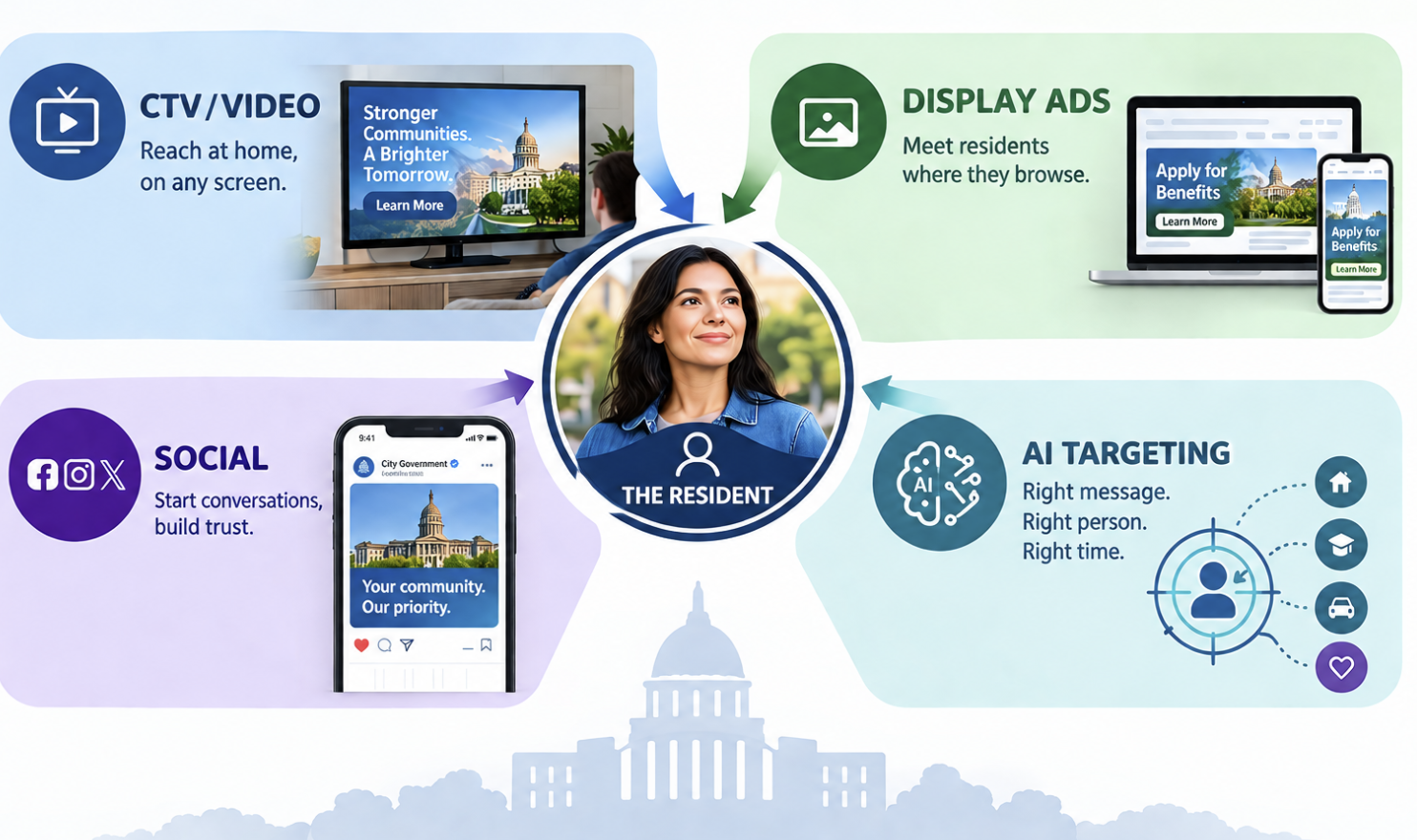
No single channel wins on its own. AI sharpens the targeting, video carries the message, CTV commands the big screen, display maintains presence, and social builds community. Their power is multiplicative when unified. Multi-channel programmatic campaigns produce 22%higher recall than single-channel efforts, and 57% of advertisers now fold CTV into an omnichannel approach precisely because it lifts overall campaign performance by around 15%.
“An omnichannel approach surrounds the resident with a consistent message, says Tricia Conwell, founder of Pacific AI Digital Media. “And reports on all of it in one place.”
Think of it the way a resident experiences it. A mom sees a 20-second CTV spot about free after-school program while watching a streaming show. The next morning a display banner reminds her on her local news app. At lunch, a short vertical video appears in her social feed with a “check eligibility” button. Each touch reinforces the last, in her language, timed to her day. That's not five campaigns — it's one campaign, orchestrated and cohesive. Because it's unified, the public agency can finally answer the question leadership always asks: who saw it and did it work?
Omnichannel campaigns are how public messages stay visible in a fragmented world that never stops scrolling. For government agencies, the stakes are higher. Reaching every community, including those historically underserved by traditional media, is a matter of equity and mission. An integrated approach, governed with the transparency and stewardship public work requires, is the most reliable way to make sure the message reaches the whole public, not just the easy-to-reach part of it.
About Pacific AI Digital Media
Pacific AI Digital Media is a full-service advertising agency specializing in public outreach. Out team of experts help government agencies, counties, districts, cities, and public institutions turn complex outreach initiatives into clear, measurable, omnichannel campaigns. By combining artificial intelligence technology, video, connected TV, programmatic display expertise, and social strategy under one coordinated approach, wedeliver the reach, visibility, and accountability that public work demands —reaching every community with the right message, on the right screen, at the right time. From public health and safety to workforce recruitment and benefits awareness, we translate mission into impact.